
Exploration in an Age of Uncertainty: Lessons from Chinese Artist Ou Yang 中国当代女画家鸥洋访谈分享
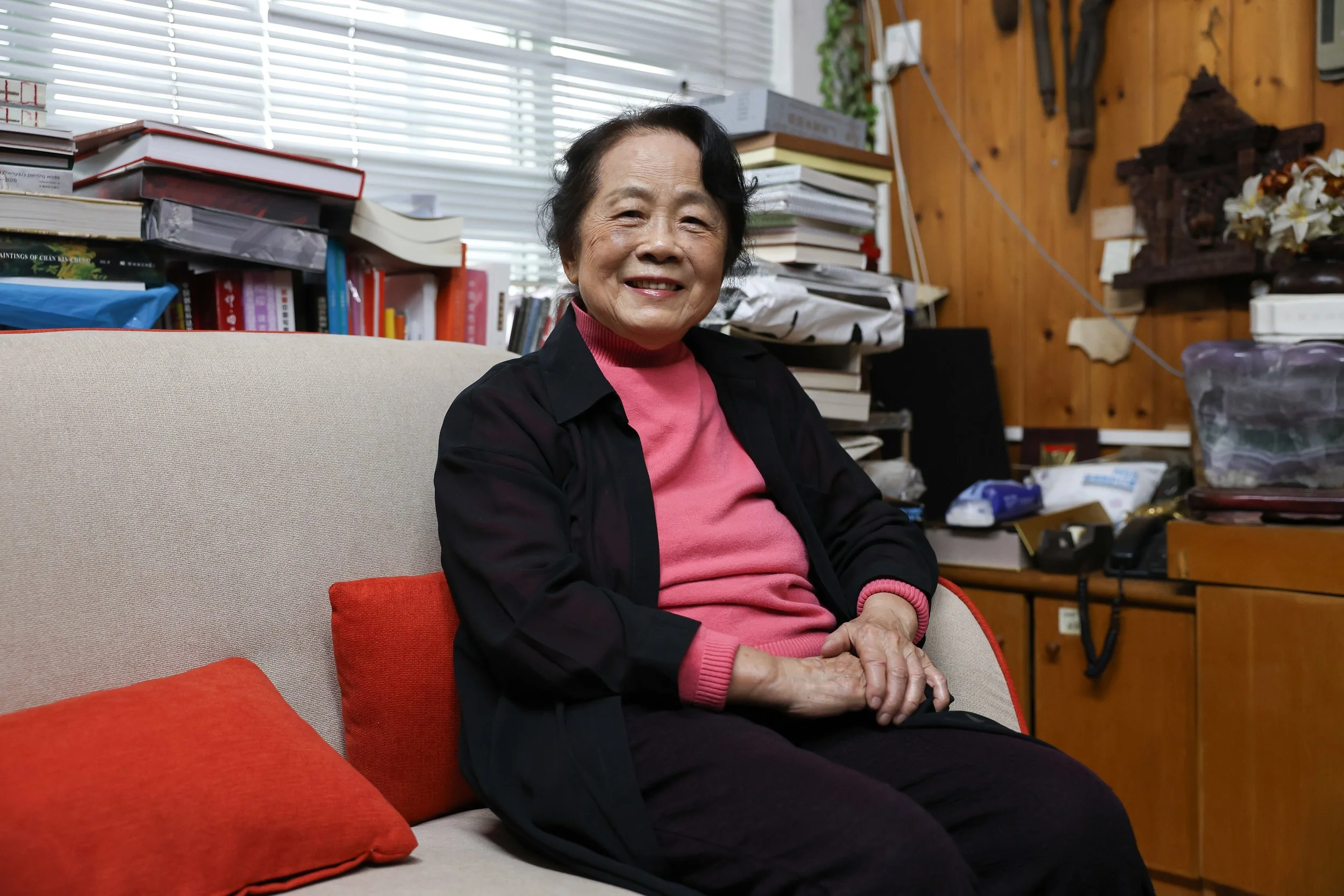
Photo of Ou Yang (© Alison Kung).
Last week, I travelled to Guangzhou with my friend Kimberly Lee, a research associate from the Wereldmuseum in the Netherlands, to interview the Chinese female artist Ou Yang 鷗洋 (b. 1937).
Ou Yang is an extraordinary painter: a former professor at the Guangzhou Academy of Fine Arts, a committee member of the China Oil Painting Society, and a student of the renowned Chinese-French artist Zao Wou-Ki (1920–2013). She is best known for her imagist oil painting (意象油畫), which integrates Western oil-painting techniques with Chinese aesthetic and philosophical traditions.
This article does not aim to analyse Ou Yang’s artworks or summarise her artistic achievements. Instead, I want to focus on what I learned from her life— and how her experiences speak directly to the confusions and uncertainties faced by our generation.
Credentialism and the Anxiety of Our Twenties
For many of us in our early to mid-twenties, thinking about the future often brings confusion, anxiety, and a sense of being stuck.
We live in an age of increasing credentialism. Almost everything, regardless of scale, now seems to require formal qualifications, certificates, or micro-credentials. This creates a persistent sense of anxiety: even when we are capable, we worry that we are never “qualified enough,” and it can feel especially daunting to compare ourselves to others’ lists of qualifications. Yet holding a certificate does not necessarily mean that someone has mastered the relevant knowledge or skills. At the same time, lacking formal qualifications can make it extremely difficult to enter certain industries or fields.
Beyond this, many young people struggle to find a place for themselves within today’s social and economic structures. Over the past decade, global development has prioritised technology-driven industries, leaving many humanities students feeling marginalised, as if they have little space to imagine a viable future in the contemporary world.
Our conversation with Ou Yang offered a powerful counter-example. We learned how someone trained in music entered an art academy with no formal artistic background, how an oil-painting graduate went on to build a professional career in gouache, and how lifelong curiosity allowed her to keep developing her own artistic language across radically changing political and cultural environments.
Her artistic life shows how one can continue to pursue what one truly wants, even under constraint, through exploration, persistence, and invention.
Starting from a Blank Sheet
Before entering the Guangzhou Academy of Fine Arts in 1956, Ou Yang studied music. During her high-school years, she composed songs and had her work published. When she began formal art training, however, she described herself as “a blank sheet of paper”. She did not know how to hold a brush properly, and her academic performance initially ranked near the bottom of her class.
What stood out was her intense curiosity and her eagerness to experiment. She approached every subject and every course with openness and seriousness, constantly trying, learning, and refining. By the time she graduated in 1960, she had become the top student in her cohort.
After graduation, Ou Yang remained at the Academy as a lecturer. Although trained in oil painting, she was assigned to teach gouache painting (水粉畫), a medium she had never studied. At the time, gouache paints were not available in China. What artists used instead were poster colours (廣告色), pigments originally intended for public posters, which Ou Yang adopted for her work.
She embraced this unfamiliar situation as a space for exploration. Drawing on her oil-painting background, she applied oil-painting methods to gouache and gradually developed new techniques and modes of expression. As she repeatedly emphasised during our interview, she enjoys doing things that others have not done before.
Through continuous experimentation, she pioneered the use of gouache for figure painting and life studies in China. She later compiled her experiments and techniques into a published volume, and her gouache figure works brought a steady stream of commissions for propaganda posters (宣傳畫) from publishers.
This stage of her life reminds us that even when we enter a field with no prior experience, curiosity and sustained exploration can open unexpected paths, and even establish new precedents.
Creating “Sunlight” in a Red Era
During the Cultural Revolution of the 1960s and 1970s, China’s art world was dominated by overwhelmingly “red, bright, and luminescent” (紅光亮) imagery, centred on workers, peasants, soldiers, and heroic figures.
Ou Yang, however, had always been highly sensitive to colour. Yet at the time, subtle colour tones or restrained palettes were criticised as bourgeois, insufficiently revolutionary, or detached from the masses.
Faced with these constraints, she chose not withdrawal, but innovation. She turned to Chinese ink painting, applying Western concepts of light and shadow to traditional formats. She painted children under sunlight, works characterised by what she described as a strong “sense of sunlight” (陽光感很重). One representative example is Young Eagle Spreading Her Wings 雛鷹展翅 (1973).
Although her intention was purely artistic — a personal pursuit of light and vitality — these works were interpreted as positive and uplifting, aligning with revolutionary ideals, and were accepted by the authorities. Once again, she found a way to sustain her artistic vision within a restrictive environment.
Her experience during this period illustrates how innovation can create space for individual expression even when external conditions are tightly constrained.
Getting Lost and Moving Forward
In the 1980s, following China’s Reform and Opening-up, artistic ideas from around the world flooded into the country. New movements such as the ’85 New Wave challenged existing artistic frameworks. Despite being widely recognised as an accomplished painter by this time, Ou Yang began to reassess herself.
She realised that before the 1980s, her artistic references and influences had been largely limited to domestic and Soviet traditions. Her work began to feel narrow to her, and she entered a period of uncertainty. She experimented extensively, including painting oil on Xuan paper and wooden panels, yet continued to feel lost.
A turning point came when Zao Wou-Ki returned to China to teach oil painting at the China Academy of Art in Hangzhou. Each academy was allowed to send only one young lecturer. Already in her forties, Ou Yang was initially excluded. Yet through persistence, she eventually secured the opportunity to study with him.
She went in hoping to learn Western abstraction. Instead, Zao urged his students to treasure Chinese cultural traditions. Inspired by this advice, Ou Yang began searching for her own artistic language within Chinese painting. Drawing from bird-and-flower painting (花鳥畫), she gradually developed her distinctive imagist oil-painting (意象油畫)style, integrating Chinese aesthetic principles of imagery (意象) with Western oil-painting techniques.
Art critics later described her as one of the earliest artists in China to raise the banner of imagist oil painting, contributing significantly to the localisation of Chinese oil painting.
From this period, we learn that confusion is not a dead end. Moments of uncertainty can become openings — points from which longer and more sustainable paths emerge.
Exploration as a Way Forward
Throughout our interview, Ou Yang repeatedly emphasised that she loves exploring and doing things others have not done. It is perhaps this disposition that shaped her into such a distinctive, pioneering artist.
She shared many insights into East–West artistic exchange and imagist oil painting, but what struck me most was her deep humanistic concern for people at society’s margins. Her sincerity, seriousness, and purity left a profound impression.
Ou Yang’s life reminds us that exploration is not a deviation from a path, but often the way a path is made. Rather than seeing exploration as something forced upon us by uncertainty or external constraints — and therefore a source of anxiety — we might begin to see it as an active, chosen process, one that we can enjoy.
Today, young people across the world live with persistent anxiety. Rapid social and technological change has made uncertainty feel unavoidable. Yet when we are asked to change, or to step into a completely unfamiliar field, what appears to be a dead end may instead be an opening.
Life is short. Do not spend it consumed by anxiety. Regardless of the world or our surroundings, we can choose to try — and to try again. If one attempt fails, we can make another. If we fall or make mistakes, we can begin once more. What is most precious about us, as human beings, is our capacity for resilience.
The environment may change, but we can change too. Do not despair too early. There is still so much in this world waiting to be explored and created.